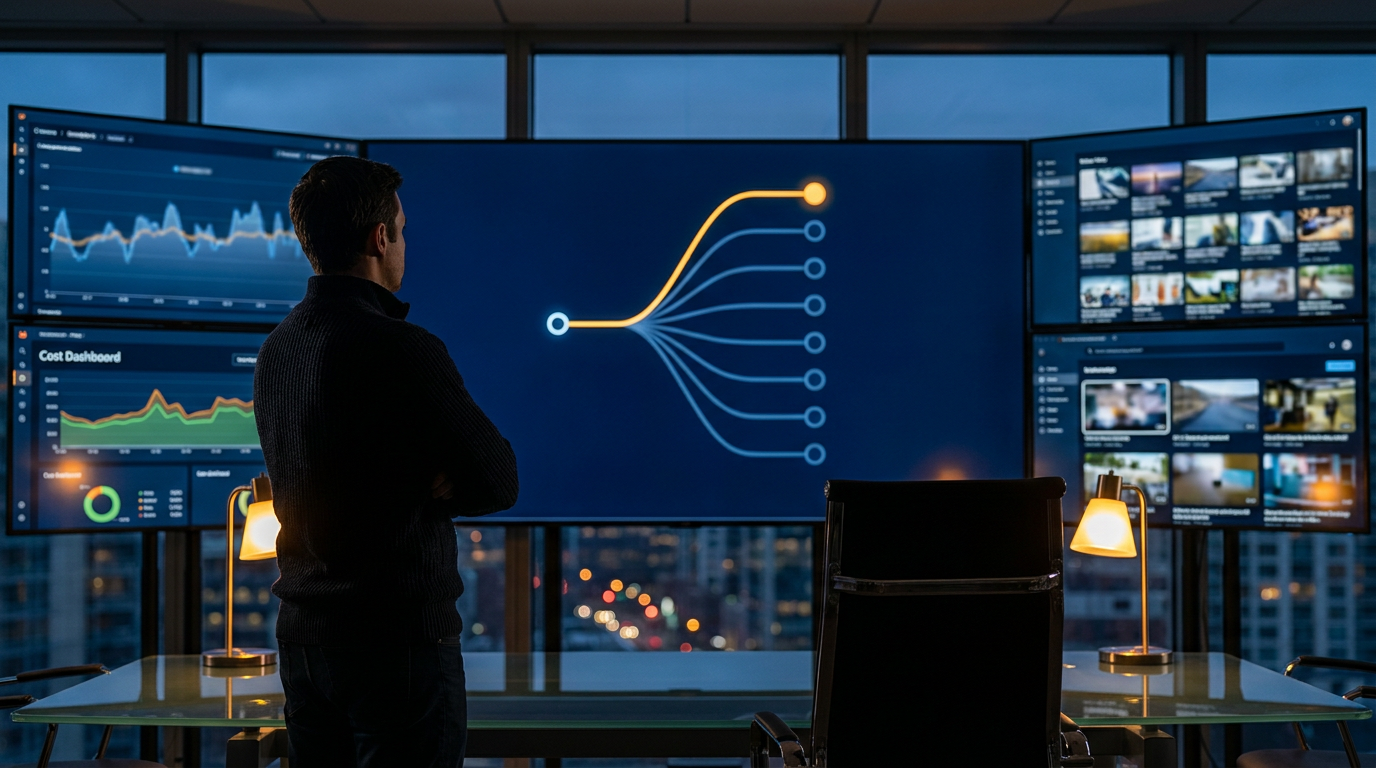
The cover image of this article was generated by AI (Gemini 3 Pro Image model on the FOTOhub.app platform). Labelled in accordance with Article 50 of the AI Act.
For the past few years, the AI market has conditioned us to ask one convenient question: which model is the best? GPT or Claude? Gemini or Llama? Veo or Kling? FLUX or Imagen? It is a simple question. It makes for compelling headlines and fuels an endless stream of rankings. It has only one flaw: it is becoming increasingly disconnected from how production-grade AI systems are actually built.
There is no best AI model. There is only the model best suited to a specific task, budget, output format, response-time requirement, security policy and quality threshold. I would use one engine to produce an image preview and another to render the final key visual. One model might be right for a short product clip, while another may be better at a scene that requires stable camera movement. Transcription, voice synthesis and visual quality control are different problems again, each with its own optimal tool.
That is why the next major battle in AI will not be fought solely over parameter counts, benchmark scores or the most spectacular product demo. It will be fought over the layer capable of understanding a task, evaluating the available resources, selecting the right model, validating the result, triggering a fallback and calculating the true cost of the entire operation. That layer is routing.
Routing is often presented as a minor technical component: a switch placed in front of several models. That definition is far too shallow. In a mature generative system, the router is a decision engine. It does not merely answer, "Which API should handle this request?" It answers a far more important question: "Which execution path is most likely to deliver an acceptable result within the applicable constraints?"
The distinction is fundamental.
The model generates. The router decides who should generate, under what conditions, in what sequence and what should happen when the first decision fails. As the market matures, this is precisely where value will migrate: away from isolated models and towards systems capable of managing them intelligently.
The Convenient Illusion of One Model
A monolithic AI architecture is attractive because it simplifies the product. One API, one provider, one pricing model, one set of parameters and one documentation stack. The problem emerges when that architecture faces real production traffic. Requests are not homogeneous. They vary by complexity, modality, context, risk, deadline, output format and tolerance for error.
Sending every task to the strongest model is like delivering every parcel by helicopter. It may work technically, but it makes no economic sense. Sending everything to the cheapest model creates the opposite problem: the system saves money on an individual call, then loses it through revisions, retries, rejected outputs and human intervention.
The routing literature generally frames this as an optimisation problem across quality and cost. A router selects a model - or another system component - to maximise expected quality under a budget constraint. Crucially, "cost" does not have to mean token pricing alone. It can include latency, compute consumption, energy use, availability risk, moderation overhead and the downstream cost of repairing an inadequate result.
This leads to an uncomfortable conclusion. The model with the lowest per-call price may not be the cheapest model for the product. If its outputs are rejected more frequently, require multiple regenerations or consume an operator's time, its total cost can exceed that of a more expensive model that produces an acceptable result on the first attempt.
In creative production, the correct economic unit is not the cost of generation. It is the cost of an accepted asset. If Model A is half the price of Model B but requires four attempts instead of one, the supposed saving exists only in the provider's pricing table. It does not exist on the company's income statement.
Routing Is Not a Model Catalogue
Giving users access to many models through one interface does not create intelligent infrastructure. A catalogue solves the access problem. A router solves the decision problem.
The simplest multi-model system leaves the choice to the user. The user selects a model, configures its parameters and accepts responsibility for the outcome. This can be useful for experts, but it scales poorly. As the number of available models grows, so does the number of decisions required before even a straightforward operation can begin. A user should not have to understand the latest differences between dozens of model versions merely to produce a banner or a video variation.
A genuine router begins operating when the system can analyse the request and predict which candidate is most likely to satisfy it. AWS describes intelligent prompt routing in Amazon Bedrock as a mechanism that analyses the content and context of a prompt, predicts model response quality and then selects an appropriate quality-cost combination for that request. Microsoft's model router uses a single deployment that evaluates factors such as complexity, cost and expected performance in real time, while the response identifies the underlying model selected. OpenRouter takes a different approach: it classifies requests by task type, considers model capabilities and price, and incorporates aggregated market behaviour from a rolling seven-day window.
These systems differ in methodology, scope and constraints. What they share is more important: routing is no longer a niche optimisation reserved for sophisticated infrastructure teams. It is becoming a product category in its own right.
Routing, Cascades and Mixture-of-Experts
Discussions of routing often conflate three different mechanisms. They need to be separated because each operates at a different layer.
Mixture-of-Experts, or MoE, is usually part of a single model's internal architecture. An internal gate activates a subset of specialised subnetworks to process a particular piece of input. From the user's perspective, however, it remains one model. The user is not managing an external pool of independent providers, tools or workflows.
Cross-model routing operates outside the model's internal computation. It may select a separate model, service, knowledge source, tool or entire workflow. Candidates can differ by provider, modality, price, data location and operational requirements. Research surveys emphasise this distinction: an external router operates independently of a model's hidden computation layer and may route requests not only to neural networks, but also to other components of the system.
A cascade is different again. It begins with a cheaper or faster model, evaluates the output and only then decides whether to escalate. If the result passes the quality threshold, the process ends. If it fails, the request is sent to a more capable model. Cascades can be highly effective, but they pay for additional confidence with additional latency because some requests generate multiple outputs.
Mature infrastructure may combine all three. It may route before generation, evaluate the result, trigger a cascade when necessary, and use a selected model that itself relies on an MoE architecture. These concepts are not competitors. They are distinct layers of the same stack.
Decisions Before Generation
The cheapest decision is the one made before an expensive model is invoked. A router can classify a task by domain, modality, complexity, technical requirements and predicted difficulty. It can then send the request directly to the most appropriate executor.
Such a router may begin with simple rules. If the user requires a transparent background, only models or pipelines supporting that format remain eligible. If the task requires sound to be generated alongside video, some video models can be eliminated immediately. If content must remain within a particular data region, the candidate pool narrows again.
A more advanced system learns from history. It examines similar requests and identifies which models previously produced the best outcomes. It can predict quality, completion time, expected retries and cost. RouteLLM research showed that preference-data-trained routers could, under specific evaluation conditions, reduce cost by more than two times without degrading response quality. That result comes from language models and specific benchmarks rather than creative generation, so it is not a universal promise. It nevertheless demonstrates that model selection can be framed as a learnable prediction problem.
Importantly, the router does not always need to be complex. Comparative studies have found that straightforward k-nearest-neighbour approaches can compete with more sophisticated neural routers while requiring substantially less training compute. More recent work on generalisation also suggests that retrieving similar historical requests can perform well with only a small fraction of the available data.
This is a valuable lesson for product teams. A system does not become intelligent because its router contains more layers. It becomes intelligent when it uses meaningful signals, optimises the correct objective and learns from real outcomes.
Decisions After Generation
Some tasks cannot be assessed reliably from the prompt alone. Two seemingly similar requests can lead to radically different outputs. In those cases, the system needs evidence from the first attempt.
A cascade can test an output for brief compliance, required elements, text legibility, content safety, technical specifications, character consistency or file correctness. If the result falls short, the router can switch models, add a reference, change parameters, trigger a repair step or hand the task to a human.
FrugalGPT demonstrated on language tasks that cascaded use of multiple models could, in specific experiments, match the best individual model while reducing cost by as much as 98%, and could improve quality by up to 4% at the same cost. Those figures should not be transferred directly to image, video or commercial production. Their real significance lies in the mechanism: the expensive model does not need to handle every request if the system can identify the cases that genuinely require escalation.
The most practical architecture will probably be neither a pure router nor a pure cascade. It will first perform an inexpensive selection before generation, then validate the result and finally escalate only where the expected value of improvement exceeds the additional cost.
Multimodality Changes the Problem
Routing text is difficult. Routing a creative workflow is several levels more difficult because the input may include a written brief, reference image, product file, voice sample, brand palette, previous shot and channel-specific technical constraints - all at the same time.
A text-only router may inspect the prompt and classify the task as simple. The reference image may contain small typography, unusual perspective, complex geometry or a product detail that must not change. If the decision engine cannot see that information, it is routing on an incomplete state.
MMR-Bench was created to examine the routing of multimodal models across tasks including OCR, visual question answering and mathematical reasoning. Its authors found that a router using both image and text signals achieved a better cost-accuracy trade-off than variants relying on only one modality. In some experiments, the system matched or exceeded the strongest single model at approximately one-third of its cost. This remains a laboratory result dependent on the selected models, tasks and cost calculation. Its implication is nevertheless important: multimodal decisions should be based on multimodal inputs.
The same direction is visible in vision-language benchmarks. VL-RouterBench covers 14 datasets, 17 models and more than half a million sample-model pairs, with metrics incorporating accuracy, cost and throughput. The emergence of benchmarks like this shows that the industry is moving beyond "Which model sees best?" towards a more operational question: "How do we automatically select the right model for this specific image and this specific request?"
Images Need Routing Too
Image generation was long treated as a straightforward choice of one model and a number of denoising steps. Yet even at this level, there is significant room for intelligent allocation of compute. A simple prompt does not always need the most expensive pipeline. A complex scene combining typography, a product, people and precise composition may require a different model, more inference steps or additional validation stages.
CATImage studies routing across nine predefined image-generation configurations. The system selects both a model and a denoising-step count based on prompt complexity. In tests using COCO and DiffusionDB, the method achieved a stronger quality-cost trade-off than always using a fixed configuration, as measured by several metrics including CLIPScore, ImageReward, aesthetic score and sharpness.
This does not prove that an automated metric can replace a creative director. It cannot. It proves something more immediately useful: the same computational budget should not be allocated identically to every prompt.
Other research into edge-cloud routing for text-to-image systems explores sending easier tasks to a lightweight local model and harder ones to a larger cloud model. In experiments, RouteT2I reduced cloud-model calls while maintaining quality, although the result depended on the model pair, dataset and evaluation metric used. The principle matters more than the isolated figure: execution location can itself become a routing decision.
In professional production, an image router must know more than whether a prompt is "easy." It must understand whether the task requires accurate typography, realistic skin, product fidelity, identity preservation, local editing, transparency, batch variation or a particular licensing profile. Quality is not one number. It is a set of acceptance conditions.
Video Exposes Weak Routers
With an image, the system can evaluate a single output. With video, it has to assess a sequence. Temporal stability, motion quality, geometry, character consistency, camera behaviour, audio, lip synchronisation and continuity across shots all become part of the problem.
A model that excels at dynamic movement may not be the best choice for a product scene. A high-resolution model may be slower and more expensive, making it a poor option for storyboarding. Another may be ideal for rapid camera-motion tests but unsuitable for the final export. Yet another may perform well in image-to-video workflows but struggle with pure text-to-video generation.
A video router therefore should not select one model for an entire project. It should make stage-level decisions. A fast model can produce an animatic. A more expensive model can render approved shots. Separate tools may handle lip-sync, interpolation, upscaling, sound and compliance checks.
At this point, routing is no longer merely model selection. It becomes execution-graph planning. Choosing the model is one decision among many, alongside operation order, data transfer, intermediate formats, retry limits and human approval gates.
The Router Must Understand the Business Objective
There is no objectively best selection because different users optimise for different objectives. An agency producing a final commercial may prioritise quality and predictability. An e-commerce company producing tens of thousands of product variants may prioritise cost, throughput and consistency. A newsroom operating under deadline pressure may accept somewhat lower quality in exchange for an immediate result. A regulated organisation may place data residency and auditability above every other parameter.
A mature router should therefore operate through policies, not merely through model choices. The user or organisation defines a priority - quality, cost, speed, privacy, reliability or a combination of them. The system selects its execution path in accordance with that policy.
This direction is already visible in infrastructure products. OpenRouter allows users to constrain the model pool and select a cost tier while considering required capabilities such as tool use. Amazon Bedrock exposes a configurable quality-difference threshold and a fallback model. In Microsoft Foundry, router deployment costs are the sum of the selected underlying models, while monitoring can segment results by the base model used.
This matters because a router without user control can quickly become a black box. It may lower cost at the expense of quality, increase quality at the expense of latency or route data to a model the organisation does not permit. Intelligence without policy is not a competitive advantage. It is a risk.
Predicting Quality Is Not Enough
A production-grade router needs to account for at least six classes of signals.
- Functional compatibility. The model must support the required input, output, format, resolution, duration, tools and control parameters.
- Predicted quality for the specific task. This is not the model's average benchmark performance. It is the probability that it will satisfy the acceptance criteria of this brief.
- Marginal cost. This includes generation, transfer, storage, auxiliary steps and expected retries.
- Latency. The router needs more than an average response time. It should understand variance, queues, provider rate limits and timeout risk.
- Reliability. A model may offer the highest quality while being unavailable, overloaded or rate-limited. Production requires a fallback.
- Policy. This includes privacy, data region, licensing, safety, auditability and brand rules.
The decision can be expressed as maximising expected utility:
Here, is the predicted quality of model for task , is cost, is latency and is risk. The weights , and depend on the product policy. Quality may dominate for a final render. Cost and speed may carry greater weight in mass preview generation.
This equation does not solve the problem. It structures it. The hardest part remains estimating each component credibly before the task has been executed.
A Benchmark Is Not Production
Routing can look deceptively good on a chart. If we possess a complete table of every model's result for every request, we can construct an "oracle router" that always chooses the winner. A real system does not know the outcome before generation. It has to predict it.
LLMRouterBench, which covers more than 400,000 instances, 21 datasets and 33 models, confirmed that models are complementary. It also found that many routing methods perform similarly under standardised evaluation. Some sophisticated routers, including commercial systems, did not reliably outperform a simple baseline. The authors also identified diminishing returns from adding more models and highlighted the importance of carefully curating the candidate pool.
That should temper the marketing enthusiasm. More models do not automatically produce better routing. If the models share similar strengths and weaknesses, additional options increase complexity without adding meaningful value. The router needs complementarity, not a catalogue.
Generalisation is equally important. A router trained on yesterday's pool may fail after a new model is added. A router trained on benchmark questions may misjudge real client briefs. A router using average prices may make poor decisions after pricing or capacity changes. Research surveys identify weak generalisation, inconsistent experimental standards and failure to capture non-financial costs as major open challenges.
A strong router is therefore not a classifier trained once and left untouched. It is a measurement system. It has to continuously collect data on outcomes, costs, latency, errors, revisions and user acceptance. Without that feedback loop, it will gradually optimise for a world that no longer exists.
The Hardest Question: What Is Quality?
In mathematics, an answer may be correct or incorrect. In creative production, quality is multidimensional and partly subjective.
An image can be beautiful and still misrepresent the product. A video can be spectacular and still violate the brand system. A voice can sound natural while carrying the wrong intonation. An asset can follow the prompt and remain unusable in the campaign.
Automated metrics can help measure sharpness, similarity, text-image alignment, object presence and artefacts. They cannot replace the business brief. A router needs a hierarchy of criteria. Some are hard constraints: format, resolution, absence of prohibited elements, presence of a logo. Others are soft: aesthetics, emotion, appeal and originality.
The most valuable signal may ultimately come from user behaviour. Which variation was downloaded? Which one did the client approve? How many times was it regenerated? Did the user return to a previous version? Was the asset actually published? These signals are more useful than a generic "like" because they reflect the real workflow.
This does not mean every decision should be automated. High-value production will continue to require human judgment. The router's purpose is not to replace taste. It is to reduce the number of situations in which people waste time on outputs that are technically unusable.
Observability Is Part of the Product
If a system chooses models automatically, it must be able to explain its behaviour at least at an operational level. Which model was selected? Why? What was the predicted cost? Was a fallback triggered? How many attempts were made? Which stage failed? Did escalation improve the result?
Without those answers, the team cannot determine whether the router actually works. It sees only the final bill and the user complaints.
The observability layer should record the routing decision, policy version, model version, parameters, latency, cost, automated evaluation and user signal. Only this trace makes A/B testing, regression detection and safe model onboarding possible.
Reproducibility also matters. Models, prices and availability change quickly. If the system cannot explain a month later why it used a particular provider, it is not serious enterprise infrastructure.
Fallback Is Not Optional
Routing diagrams usually show an elegant arrow pointing towards the best model. Production is less orderly. Providers experience outages, enforce limits, change versions, reject content, return errors and deliver different response times across regions.
The router has to assume that its first choice may fail. A fallback cannot mean blindly sending the same request to the next API. Models have different parameters, formats, safety rules and capabilities. The request must be translated, the response normalised and the fallback checked against the original requirements.
Sometimes the correct decision is not to invoke another model. If an output fails a hard constraint, the system should stop the workflow, request missing information or escalate to a human. Reliability does not mean generating at any cost. It means terminating safely when appropriate.
Routing Will Become the Control Layer
As agents evolve, the router will make decisions repeatedly within a single assignment. An agent may analyse a brief, plan a campaign, build a storyboard, generate images, produce video, synthesise a voice, localise the content and export multiple variants. Each stage has a different objective function.
If every step is hard-wired to one model, the agent is merely a long script attached to an expensive API. Dynamic routing is what allows tools to be matched to tasks and budgets.
The router can also operate at several levels simultaneously. One layer selects the workflow. Another selects the model for a particular node. A third selects the provider or region for the same model. A fourth validates output and decides whether to escalate. A fifth manages queues and compute capacity.
In this architecture, the model becomes a replaceable executor. The lasting value of the product lies in project state, policy, evaluation data, decision history, integrations and the ability to carry a process reliably from brief to result.
What This Means for FOTOhub
FOTOhub publicly positions itself as an AI Creative OS combining image, video, audio and 3D generation with storage, automation and developer infrastructure. According to its official press kit, the platform integrates more than 200 models from over 10 providers through a common API and SDKs for Python and TypeScript.
That breadth creates value only if the number of models does not become a burden transferred to the user. Two hundred entries in a dropdown are not an advantage by themselves. They can become a problem. The advantage begins when the system understands which resources to invoke for a particular objective.
FOTOhub's published architecture describes FOTOcore AI as a central layer coordinating internal and external models and routing tasks to appropriate systems. External communication should nevertheless maintain a strict distinction between production features, experimental mechanisms and the roadmap. A rule-based decision is not automatically machine learning. A cost optimisation is not necessarily an intelligent router. A fallback is not necessarily an agent.
The most credible narrative is not, "FOTOhub always chooses the best model." No responsible platform can make that promise. A stronger and more technically defensible position is this: FOTOhub is building a layer designed to measure model performance in specific workflows, enforce constraints and select execution paths based on quality, cost, time and user policy.
That positioning avoids the trap of comparing FOTOhub with foundation-model developers. The objective does not need to be training the largest model in the world. It can be building the system that knows when to use each model, how to combine it with other tools and how to deliver a completed result to the user.
For a creative platform, routing must encompass more than generator selection. It should manage the entire chain: brief analysis, modality selection, preview generation, final rendering, quality control, repair, upscaling, sound, storage and export. Only then does the orchestration layer become a product rather than a wrapper around third-party APIs.
The Moat Is Not the Number of Integrations
Integrations can be copied. Access to a popular API is available to many companies. An interface with a model selector is not a durable barrier either.
What is harder to copy is data about how models behave within specific workflows. Which model performs best on a white-background product shot? Which one preserves a face through several transformations? Which produces the most useful storyboards? Which remains fast during peak hours? Which requires the fewest retries in a particular industry?
Harder still is a system that learns from these signals and improves decisions without destabilising the product. That feedback loop can become an infrastructure moat.
This is not an argument for collecting users' prompts without controls. It is an argument for designing secure, aggregated operational signals: task success, retry count, latency, cost, error type, output acceptance and requirement compliance. A router needs data, but a mature product also needs privacy controls, retention policies, consent mechanisms and a clear separation between telemetry and customer content.
Routing Does Not Eliminate Lock-In
Multi-model architecture is often sold as an antidote to dependence on a single provider. That is only partly true.
A router can make it easier to switch models, but the organisation may become dependent on the orchestration layer, its data format, policies, evaluation framework and accumulated history. If the router is a non-portable black box, lock-in has not disappeared. It has moved up the stack.
Good infrastructure should therefore support manual model overrides, log export, custom policies, candidate testing and side-by-side evaluation. Business users do not need to understand every endpoint, but they should be able to control the boundaries of automation.
Owning the routing layer offers another strategic advantage: it separates the product from the model. A model can be replaced when quality declines, pricing rises, licensing changes or the service disappears. The product retains its workflow, data, interface and customer relationship.
How the Router Can Fail
- Confidence in a wrong decision. The most dangerous failure occurs when the router is confident and wrong. It may classify a task as easy, choose an inexpensive model and produce an output that appears plausible while violating a critical requirement. If the validator misses the problem as well, automation scales the error.
- Drift. A provider updates a model, changes its safety filters or introduces a new version under the same product name. Historical performance stops predicting future behaviour.
- Manipulation. If the router trusts user-declared complexity, a user may force an expensive model or evade policy. If the router relies on a language model for classification, it becomes an attack surface itself.
- Local optimisation. A router may keep selecting models it already understands, limiting data collection for new candidates. Controlled exploration is necessary, but every experiment costs money and can reduce quality.
- The wrong metric. If the team optimises only per-call cost, the router will learn to produce cheap outputs rather than useful ones. If it optimises clicks, it may reward spectacle over brand compliance. If it optimises an automated evaluator's score, it may learn to satisfy that evaluator rather than the human decision-maker.
Routing does not remove responsibility. It concentrates responsibility in the decision layer. The more autonomy the system receives, the more important testing, limits, observability and emergency stops become.
How I Would Build a Router for Creative AI
I would not begin by training a sophisticated network intended to predict everything. I would begin by structuring the problem.
- A task taxonomy. Generation from scratch, editing, identity preservation, typography, product imagery, storyboarding, image-to-video, lip-sync, dubbing, music, upscaling and safety validation should not be treated as one undifferentiated category.
- An explicit capability registry. Not marketing descriptions, but tested properties: supported inputs, formats, limits, resolution, latency, cost, data region, licence, version and API stability.
- A performance matrix built from real tasks. Each model should be evaluated not only on public benchmarks, but also against representative product workflows. The evaluation should combine hard validators, automated metrics and samples assessed by people.
- A simple rule-based or similarity-based router. Research indicates that simple methods can be competitive with complex alternatives, so increasing architectural complexity before collecting quality data would be a mistake.
- A controlled cascade. If a low-cost model fails the threshold, the task escalates. If an output violates a hard constraint, it does not advance regardless of its aesthetic score.
- Observability. Every decision must leave a trace that can be analysed later.
- A more sophisticated router, only then. Only then would I train a more sophisticated router - not to answer the abstract question "Which model is best?", but to solve a concrete one: "Which execution plan maximises the probability of acceptance within this budget, deadline and policy?"
The Cost That Matters Is the Cost of Acceptance
The market has spent years comparing prices per token, image, video second or audio minute. Those metrics are convenient for providers and insufficient for customers.
A company is not buying tokens. It is buying a solved problem. An agency does not need five generated videos. It needs one video the client approves. An online store does not need a thousand images. It needs a thousand correct product pages.
The primary metric should therefore look like this:
The cost of an accepted result includes generation, validation, retries and human labour, divided by the number of outputs that actually move into use. This calculation can reverse the ranking of models completely.
The router should optimise for precisely this value. Otherwise, it may improve the API invoice while making the economics of the overall workflow worse.
Why the Middle Layer Will Win
Foundation models will continue to improve. Some will become cheaper, some faster and some more specialised. That does not mean one model will absorb every task.
Infrastructure history offers a consistent lesson: as the number of resources grows, the layer that manages them becomes more important. In cloud computing, success does not come from manually assigning every job to a server. Database users are not expected to plan every query by hand. Network operators do not manually select the route of every packet.
Generative AI is moving in the same direction. Users will choose models less often. They will specify an objective, constraints and an expected outcome. The system will decide which resources to use.
That does not mean model brands will disappear. The best models will continue to create advantage through superior capabilities. What will change is where product value is created. For most users, the model's name will matter less than whether the task was completed well, quickly, safely and within a predictable budget.
This is where platforms such as FOTOhub have room to build. Not by pretending that one proprietary model can replace the entire market. Not by showcasing an ever-longer list of integrations. The opportunity lies in turning model diversity into one coherent production system.
The Most Important Model May Be the Router
For a long time, advantage was defined by the quality of an individual model. Then it was defined by access to multiple models. The next stage will be defined by the ability to select, combine and control them.
There is no best AI model because "best" has no meaning without context. A model can win a benchmark and fail in a specific workflow. It can be cheap per call and expensive in operation. It can be fast but unreliable. It can produce beautiful images that never pass brand approval.
Routing will therefore not remain an optional component of generative infrastructure. It will become its control layer. It will shape quality, economics, reliability, safety and scale.
The decisive shift is not that we will have more models. It is that we will stop selecting them manually.
The model will perform the work. The router will decide how that work should be performed intelligently.
That decision may prove to be the most valuable component in the entire system.
Sources (17)
- Doing More with Less: A Survey on Routing Strategies for Resource Optimisation in Large Language Model-Based Systems - https://arxiv.org/abs/2502.00409
- Dynamic Model Routing and Cascading for Efficient LLM Inference: A Survey - https://arxiv.org/abs/2603.04445
- RouteLLM: Learning to Route LLMs with Preference Data - https://arxiv.org/abs/2406.18665
- FrugalGPT: How to Use Large Language Models While Reducing Cost and Improving Performance - https://arxiv.org/abs/2305.05176
- Rethinking Predictive Modeling for LLM Routing: When Simple kNN Beats Complex Learned Routers - https://arxiv.org/abs/2505.12601
- VDAR-Router: Adaptive LLMs Routing via Verbalized Query Difficulty Analysis Retrieval - https://arxiv.org/abs/2607.18098
- MMR-Bench: A Comprehensive Benchmark for Multimodal LLM Routing - https://arxiv.org/abs/2601.17814
- VL-RouterBench: A Benchmark for Vision-Language Model Routing - https://arxiv.org/abs/2512.23562
- Cost-Aware Routing for Efficient Text-To-Image Generation - https://arxiv.org/abs/2506.14753
- Adaptive Routing of Text-to-Image Generation Requests Between Large Cloud Model and Light-Weight Edge Model - https://arxiv.org/abs/2411.13787
- LLMRouterBench: A Massive Benchmark and Unified Framework for LLM Routing - https://arxiv.org/abs/2601.07206
- Intelligent prompt routing - Amazon Bedrock User Guide - https://docs.aws.amazon.com/bedrock/latest/userguide/prompt-routing.html
- Model router for Azure AI Foundry Models - https://learn.microsoft.com/en-us/azure/ai-foundry/openai/concepts/model-router
- Auto Router - OpenRouter Documentation - https://openrouter.ai/docs/guides/routing/routers/auto-router
- FOTOhub - press kit - https://fotohub.app/press
- FOTOhub Docs - API reference - https://docs.fotohub.app/
- FOTOhub - Crunchbase Company Profile & Funding - https://www.crunchbase.com/organization/fotohub